Feeds:
Posts
Comments

whf_razzThe Wilson County Beekeepers Association meets Monday, 29 July 2013 at 7:00 PM at the James E. Ward Agricultural Center on the Wilson County Fairgrounds in Lebanon Tennessee.
.
The program for May will be:  Marketing Honey & Photography by Jay Williams
.

Note: After you enter the fairgrounds through the main gate, travel east until you reach the exhibit buildings, turn left and we are in the West Building on your right. Look for all the cars.

.
wcba

shawnee_business

…

The story goes like this: David’s father, Arthur Hoehn, was looking for a way to stay busy when he retired. So, one day, he bought some bees.

David Hoehn’s father, Arthur, right, taught the family everything they know about beekeeping. Arthur was a beekeeper for 27 years, raising up to 70 hives at his peak. He died in April, but this photograph hangs in the family’s honey house so Arthur can keep an eye on things.

“The thing about beekeeping is it gives you something to do all year long,” David says. “In the spring, in the summer. In the winter you work over the boxes, cut out all the rotten wood. And the next thing you know, here come the bees again.”

Arthur’s hobby blossomed into an obsession. At the height of it, he managed 70 hives, producing hundreds of gallons of honey each year.

“When you have one hive, you want two. When you have two, you want four,” David explains. “And if you got four hives, you want eight — that’s just being a beekeeper.”  [ … continue reading ]

Source: http://www.shawneedispatch.com/news/2013/jul/25/shawnees-most-honest-business-has-no-employees-cus/

.
wcba
Honey For Sale

These local beekeepers have honey for sale

.
If you find a contact below that is in error
or no longer valid, please drop us a note at:
cedarbees@gmail.com and we will attempt
to correct it.  Thanks.
.
.

Lebanon

  • Margaret Cantrell — 615.286.1306
    .
  • Greg Tomerlin — 615.428.7799 — cedarbees@gmail.com
    .

Mount Juliet

Walter Hill

Watertown

.


.

If you have local honey for sale and would like to be listed above, send your name and contact information to: petrabee@hotmail.com

varroa_on_beeJuly 17, 2013 — Honey bees (Apis mellifera) infected with the parasitic mite, Varroa destructor, or the microsporidia, Nosema ceranae, have changes in the chemical profile of their skin and in their brains, finds research in BioMed Central’s open access journal BMC Ecology. Despite this, parasitized bees were not expelled from the hive, which, the authors say, supports the hypothesis that stressed bees leave the hive altruistically to prevent the spread of infection.

This study from INRA (French National Institute for Agricultural Research) investigated the effect of parasitization on honey bees living in hives at Avignon. Individual bees were infected with either the ectoparasite Varroa, which lives on the bees, or endoparasite Nosema, which invades their bodies, and reintroduced to the hive. After a few days the effect of infection on bees and their behavior was monitored.

Parasitization caused changes in the levels of active genes in the brains of infected bees. Varroa altered the activity of 455 genes, including genes involved in GABA and serotonin signaling, while Nosema affected 57. Twenty genes were common between the two infections and several of the up-regulated genes are involved in oxidative stress, neural function and foraging behavior. Parasitized bees also tended to have a higher viral infection as well, adding to their disease burden, — even if they did not have physical symptoms. [ …continue ]

Source: http://www.sciencedaily.com/releases/2013/07/130717051738.htm

.
wcba

by Laura Poppick, Staff Writer | July 17, 2013 02:03pm ET

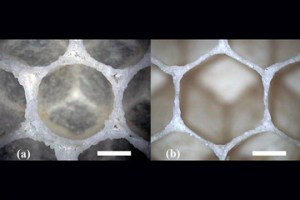
honeycomb_2The perfect hexagonal shape of honeycomb cells — once thought to be an incredible feat of math-savvy insects — has now been explained by simple mechanics.

Scientists have marveled at the angular perfection of honeycomb for centuries, but none have been able to clearly describe how it forms. Engineers in the U.K. and China have taken a step forward by showing that the cells actually start off as circles — molded by the shape of a bee’s body — and then flow into a hexagonal pattern seconds later. The researchers reported their findings yesterday (July 16) in the Journal of the Royal Society Interface.

“People have always speculated how bees have formed these honeycombs,” said Bhushan Karihaloo, an engineer at Cardiff University in the U.K. and co-author of the study, citing Galileo Galilei and Johannes Kepler as two of the luminaries mystified by the problem. “There have been some incredible, esoteric, even bizarre explanations; [some people] believed the bees had an uncanny ability to measure angles. But it’s actually much more mundane.”

Source: http://www.livescience.com/38242-why-honeybee-honeycombs-are-perfect.html

.
wcba

Beehive Detection Dog

Claudia Kawczynska | July 13, 2013

beekeeper_dog

Bazz, wearing his new bee-proof working gear, is Australia’s first apiary dog. Beekeeper Josh Kennett devised this suit so that his Lab, and working partner, Bazz could help sniff out a virulent bee disease, the American foulbrood.

Dogs can’t get near a hive of bees without being aggressively chased away. So Kennett got the idea to train Bazz from his American counterparts but in the U.S. the colder temperatures negate the need for protection. [… continue reading ]

Source: http://thebark.com/content/beehive-detection-dog

.
wcba