Feeds:
Posts
Comments

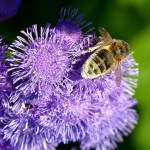
bee_on_pollenThe Wilson County Beekeepers Association meets Monday, 6 May 2013 at 7:00 PM at the James E. Ward Agricultural Center on the Wilson County Fairgrounds in Lebanon Tennessee.

.
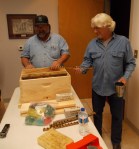
The program for May will be:  Nectar & Pollen Plants by Jim Garrison
.

Note: After you enter the fairgrounds through the main gate, travel east until you reach the exhibit buildings, turn left and we are in the West Building on your right. Look for all the cars.

.
wcba

Kent Williams

Kent Williams

The Wilson County Beekeepers Association meets Monday, 8 April 2013 at 7:00 PM at the James E. Ward Agricultural Center on the Wilson County Fairgrounds in Lebanon Tennessee.
.
The program for April will be: Swarms & Swarm Prevention by Kent Williams
.

Note: After you enter the fairgrounds through the main gate, travel east until you reach the exhibit buildings, turn left and we are in the West Building on your right. Look for all the cars.

.
wcba

Kent Williams and Carey MitchellCheck out the photos from the TBA Queen Rearing Class held Saturday, 30 March 2013.

https://wilsoncountybeekeepers.org/photos/tba-queen-rearing-class-30-march-2013/

.
wcba

Kent Williams

Kent Williams

The Wilson County Beekeepers Association meets Monday, 8 April 2013 at 7:00 PM at the James E. Ward Agricultural Center on the Wilson County Fairgrounds in Lebanon Tennessee.
.
The program for April will be: Swarms & Swarm Prevention by Kent Williams
.

Note: After you enter the fairgrounds through the main gate, travel east until you reach the exhibit buildings, turn left and we are in the West Building on your right. Look for all the cars.

.
wcba

by Sid Perkins on 27 March 2013, 2:10 PM

sn-bees-thumb-200xauto-16672The electric fields that build up on honey bees as they fly, flutter their wings, or rub body parts together may allow the insects to talk to each other, a new study suggests. Tests show that the electric fields, which can be quite strong, deflect the bees’ antennae, which, in turn, provide signals to the brain through specialized organs at their bases.

Scientists have long known that flying insects gain an electrical charge when they buzz around. That charge, typically positive, accumulates as the wings zip through the air—much as electrical charge accumulates on a person shuffling across a carpet. And because an insect’s exoskeleton has a waxy surface that acts as an electrical insulator, that charge isn’t easily dissipated, even when the insect lands on objects, says Randolf Menzel, a neurobiologist at the Free University of Berlin in Germany.

Although researchers have suspected for decades that such electrical fields aid pollination by helping the tiny grains stick to insects visiting a flower, only more recently have they investigated how insects sense and respond to such fields. [ … continue reading ]

Source: http://news.sciencemag.org/sciencenow/2013/03/bees-buzz-each-other-but-not-the.html

130327133347Mar. 27, 2013 — Two new studies have highlighted a negative impact on bees’ ability to learn following exposure to a combination of pesticides commonly used in agriculture. The researchers found that the pesticides, used in the research at levels shown to occur in the wild, could interfere with the learning circuits in the bee’s brain. They also found that bees exposed to combined pesticides were slower to learn or completely forgot important associations between floral scent and food rewards. [ … continue reading ]

Source:  http://www.sciencedaily.com/releases/2013/03/130327133347.htm

.
wcba