Feeds:
Posts
Comments

Archive for the ‘In the News’ Category

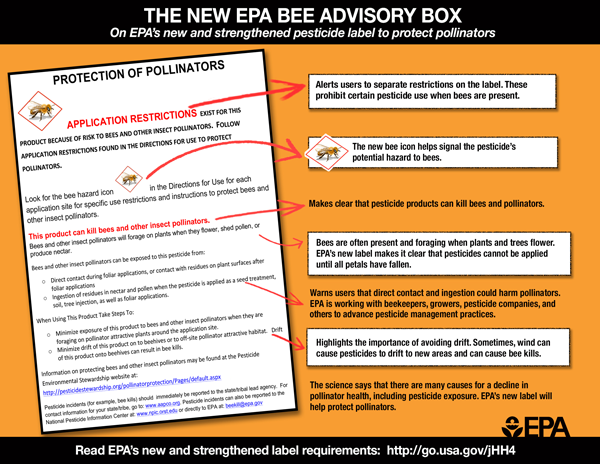
bee_label_info_graphic

WASHINGTON – In an ongoing effort to protect bees and other pollinators, the U.S. Environmental Protection Agency (EPA) has developed new pesticide labels that prohibit use of some neonicotinoid pesticide products where bees are present.

“Multiple factors play a role in bee colony declines, including pesticides. The Environmental Protection Agency is taking action to protect bees from pesticide exposure and these label changes will further our efforts,” said Jim Jones, assistant administrator for the Office of Chemical Safety and Pollution Prevention.

The new labels will have a bee advisory box and icon with information on routes of exposure and spray drift precautions. Today’s announcement affects products containing the neonicotinoids imidacloprid, dinotefuran, clothianidin and thiamethoxam. The EPA will work with pesticide manufacturers to change labels so that they will meet the Federal Insecticide, Fungicide, and Rodenticide Act (FIFRA) safety standard.

In May, the U.S. Department of Agriculture (USDA) and EPA released a comprehensive scientific report on honey bee health, showing scientific consensus that there are a complex set of stressors associated with honey bee declines, including loss of habitat, parasites and disease, genetics, poor nutrition and pesticide exposure.

The agency continues to work with beekeepers, growers, pesticide applicators, pesticide and seed companies, and federal and state agencies to reduce pesticide drift dust and advance best management practices. The EPA recently released new enforcement guidance to federal, state and tribal enforcement officials to enhance investigations of beekill incidents.

More on the EPA’s label changes and pollinator protection efforts:
http://www.epa.gov/opp00001/ecosystem/pollinator/index.html

View the infographic on EPA’s new bee advisory box:

Click to access bee-label-info-graphic.pdf

.
wcba

Read Full Post »

varroa_on_beeJuly 17, 2013 — Honey bees (Apis mellifera) infected with the parasitic mite, Varroa destructor, or the microsporidia, Nosema ceranae, have changes in the chemical profile of their skin and in their brains, finds research in BioMed Central’s open access journal BMC Ecology. Despite this, parasitized bees were not expelled from the hive, which, the authors say, supports the hypothesis that stressed bees leave the hive altruistically to prevent the spread of infection.

This study from INRA (French National Institute for Agricultural Research) investigated the effect of parasitization on honey bees living in hives at Avignon. Individual bees were infected with either the ectoparasite Varroa, which lives on the bees, or endoparasite Nosema, which invades their bodies, and reintroduced to the hive. After a few days the effect of infection on bees and their behavior was monitored.

Parasitization caused changes in the levels of active genes in the brains of infected bees. Varroa altered the activity of 455 genes, including genes involved in GABA and serotonin signaling, while Nosema affected 57. Twenty genes were common between the two infections and several of the up-regulated genes are involved in oxidative stress, neural function and foraging behavior. Parasitized bees also tended to have a higher viral infection as well, adding to their disease burden, — even if they did not have physical symptoms. [ …continue ]

Source: http://www.sciencedaily.com/releases/2013/07/130717051738.htm

.
wcba

Read Full Post »

Honey bees, which play a key role in pollinating a wide variety of food crops, are in sharp decline in the United States, due to parasites, disease and pesticides, said a federal report released on Thursday.

Download the USDA Report:  USDA_Report_Honey_Bee_Health

.
By Ian Simpson

WASHINGTON (Reuters) – Honey bees, which play a key role in pollinating a wide variety of food crops, are in sharp decline in the United States, due to parasites, disease and pesticides, said a federal report released on Thursday.

Genetics and poor nutrition are also hurting the species, which help farmers produce crops worth some $20 billion to $30 billion a year.

Honey bee colonies have been dying and the number of colonies has more than halved since 1947, said the report by the Environmental Protection Agency and the Agriculture Department.

The decline raises doubt about whether honey bees can fulfill their crucial role in pollinating crops that play a role in about one-third of all food and beverages sold in the United States, the report said.

“Overall losses continue to be high and pose a serious threat to meeting the pollination service demands for several commercial crops,” the report said.

Pollination demands have increased so much in recent years that California’s almond crop alone requires 60 percent of all managed colonies devoted to pollination — rather than honey or beeswax production.

The United States is not alone in facing this concern: The European Union moved on Monday to protect its own falling bee population by banning three of the world’s most widely used pesticides for two years.

The Varroa mite, a parasite first found in the United States in 1987, is the single biggest cause of colony loss in the United States and other countries, the report said.

Another main concern is the effect of pesticides on bee colonies. More research is needed to find out how much pesticide exposure bees get and their effects, the U.S. report said. [ … continue reading ]

Source:  http://www.scientificamerican.com/article.cfm?id=honey-bee-numbers-drop

Read Full Post »

Foraging bees prefer contrasting colors rather than stripes when they select flowers

FlowerFlower-colors-said-biggest-bee-draw colors that contrast with their background are more important to foraging bees than patterns of colored veins on pale flowers according to new research, by Heather Whitney from the University of Cambridge in the UK, and her colleagues. Their observation of how patterns of pigmentation on flower petals influence bumblebees’ behavior suggests that color veins give clues to the location of the nectar. There is little to suggest, however, that bees have an innate preference for striped flowers. The work is published online in Springer’s journal, Naturwissenschaften – The Science of Nature.

Very few flowers are a simple block of a single color. Patterns of pigmentation include color patterns within a petal or different colors on different petals. These patterns are thought to be important for pollination. Bees can identify, and are sometimes attracted to, patterned flowers over plain flowers. These patterns can increase the speed with which bees locate the nectar reward in a flower.

Venation patterns – or lines of color on flower petals – are common in Antirrhinum flowers, commonly known as snapdragons. The authors looked at the ways in which these color veins influence bumblebee foraging behavior. They exposed bees who had not seen flowers before to veined, ivory and red types of snapdragon flowers. They observed whether bees could distinguish between ivory and veined flowers and which type of flower they preferred, when they were looking for nectar.

From the bees’ perspective, red flowers reflected little light while red veins on ivory flowers slightly changed the color of the flower. The ivory background, however, had the most effect, as it contrasted with the brown background more than the red flowers did. Bees successfully discriminated between ivory and veined flowers but showed no preference for one or the other. In contrast, both ivory and veined flowers were significantly more popular than red flowers.

The authors conclude: “Venation patterns might be prevalent in nature because they can be useful nectar guides, particularly when they also increase flower visibility. But it appears that the color contrast of a flower with its background has a greater influence on bee preference.”

Source:  ABJ Extra – http://us1.campaign-archive2.com/?u=5fd2b1aa990e63193af2a573d&id=0e44f2645a

.
wcba

Read Full Post »

project_honeygate
CHICAGO — Five individuals and two domestic honey-processing companies have been charged with federal crimes in connection with a U.S. Immigration and Customs Enforcement (ICE) Homeland Security Investigations (HSI)-led investigation surrounding illegal importations of honey from China.

The charges assert that the Chinese-origin honey was misdeclared as other commodities upon importation into the United States and transshipped through other countries to evade anti-dumping duties. Altogether, the seven defendants allegedly evaded anti-dumping duties totaling more than $180 million.

According to industry experts, anti-dumping circumvention schemes like the one announced today create a divergent market which negatively affects legitimate business. To combat this, HSI and U.S. Customs and Border Protection (CBP) have stepped up efforts regarding commercial fraud investigations that focus on U.S. economic and health and safety interests.

The charges represent the second phase of an investigation led by HSI. In June 2011, an HSI undercover special agent assumed the role of the director of procurement at Honey Holding I Ltd., which by then was cooperating with the investigation.

Honey Holding, doing business as Honey Solutions, of Baytown, Texas, and Groeb Farms Inc., of Onsted, Mich. – two of the nation’s largest honey suppliers – have both entered into deferred prosecution agreements with the government. Honey Holding has agreed to pay $1 million and Groeb Farms has agreed to pay $2 million in fines. Both companies have also agreed to implement corporate compliance programs as part of their respective agreements.

“These businesses intentionally deprived the U.S. government of millions of dollars in unpaid duties,” said ICE Deputy Director Daniel Ragsdale. “Schemes like this result in legitimate importers and the domestic honey-producing industry enduring years of unprofitable operations, with some even being put out of business. We will continue to enforce criminal violations of anti-dumping laws in all industries so American and foreign businesses all play by the same rules.”

The individual defendants include three honey brokers, the former director of sales for Honey Holding, and the president of Premium Food Sales Inc., a broker and distributor of raw and processed honey in Bradford, Ontario.

In December 2001, the Commerce Department determined that Chinese-origin honey was being sold in the United States at less than fair market value, and imposed anti-dumping duties. The duties were as high as 221 percent of the declared value, and later were assessed against the entered net weight, currently at $2.63 per net kilogram, in addition to a honey assessment fee of one cent per pound of all honey.

In 2008, federal authorities began investigating allegations involving circumventing anti-dumping duties through illegal imports, including transshipment and mislabeling on the supply side of the honey industry. The investigation resulted in charges against 14 individuals, including executives of Alfred L. Wolff GmbH and several affiliated companies of the German food conglomerate. The defendants were charged with allegedly evading approximately $80 million in anti-dumping duties on Chinese-origin honey. Authorities seized and forfeited more than 3,000 drums of honey that illegally entered the United States.

The second phase of the investigation, announced today, involves allegations of illegal buying, processing and trading of honey that illegally entered the United States on the demand side of the industry. Some of that honey was adulterated with antibiotics not approved by the Food and Drug Administration (FDA) for use in honey. None of the charges allege any instances of illness or other public health consequences attributed to consumption of the honey. The investigation is continuing.

“Trade fraud can have significant implications for the U.S. economy and consumers,” said CBP Chief Operating Officer Thomas S. Winkowski. “These products take jobs away from American workers and frequently violate U.S. health and safety standards, potentially endangering the public. CBP is committed to fighting these fraudulent actors alongside our government partners.”

The government is being represented by Assistant U.S. Attorney Andrew S. Boutros in the Northern District of Illinois.

“We applaud the efforts of HSI, CBP, and other agencies involved in this complex, long-term investigation to enforce the laws that exist to protect U.S. consumers and the honey market,” said Gary S. Shapiro, U.S. attorney for the Northern District of Illinois.

The HSI-led National Intellectual Property Rights Coordination Center (IPR Center) assisted with this investigation. The IPR Center is one of the U.S. government’s key weapons in the fight against counterfeiting, piracy, and commercial trade fraud. Working in close coordination with the Department of Justice Task Force on Intellectual Property, the IPR Center uses the expertise of its 21-member agencies to share information, develop initiatives, coordinate enforcement actions and conduct investigations related to intellectual property theft. Through this strategic interagency partnership, the IPR Center protects the public’s health and safety, the U.S. economy and the war fighters.

Source:  home.ezezine.com/1636/1636-2013.02.20.17.10.archive.html

Read Full Post »
Killer in a Bottle?

Household insecticides may play a role in declining bee populations
By Becky Beyers

bee_on_dandelionVera Krischik and her lab in the Department of Entomology are exploring a different avenue: how neonicotinoids, a group of insecticides commonly used in urban gardens and forests as well as in agricultural fields, might be making bees less resistant to the parasites and pathogens that researchers now believe are likely causes of Colony Collapse Disorder.
.

Infesting the system

continue reading

.

Source:   http://www.cfans.umn.edu/Solutions/Fall2012/Killer_Bottle/index.htm

Read Full Post »

« Newer Posts - Older Posts »