
.
wcba
Archive for the ‘In the News’ Category
Happy Thanksgiving from WCBA
Posted in In the News on 26 November 2014| Leave a Comment »
Common crop pesticides kill honeybee larvae in the hive
Posted in Announcements, In the News, Science on 27 January 2014| Leave a Comment »
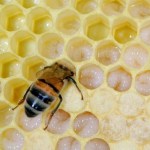 Four pesticides commonly used on crops to kill insects and fungi also kill honeybee larvae within their hives, according to new research. Scientists also found that N-methyl-2-pyrrolidone — an inert, or inactive, chemical commonly used as a pesticide additive — is highly toxic to honeybee larvae.
“We found that four of the pesticides most commonly found in beehives kill bee larvae,” said Jim Frazier, professor of entomology, Penn State. “We also found that the negative effects of these pesticides are sometimes greater when the pesticides occur in combinations within the hive. Since pesticide safety is judged almost entirely on adult honeybee sensitivity to individual pesticides and also does not consider mixtures of pesticides, the risk assessment process that the Environmental Protection Agency uses should be changed.”
According to Frazier, the team’s previous research demonstrated that forager bees bring back to the hive an average of six different pesticides on the pollen they collect. Nurse bees use this pollen to make beebread, which they then feed to honeybee larvae.
To examine the effects of four common pesticides — fluvalinate, coumaphos, chlorothalonil and chlorpyrifos — on bee larvae, the researchers reared honeybee larvae in their laboratory. They then applied the pesticides alone and in all combinations to the beebread to determine whether these insecticides and fungicides act alone or in concert to create a toxic environment for honeybee growth and development. [ … continue reading ]
Source: http://www.sciencedaily.com/releases/2014/01/140127122825.htm
.
wcba
Male Honey Bees More Susceptible Than Females to Nosema ceranae
Posted in In the News, Science on 21 January 2014| Leave a Comment »
Jan. 18, 2014 — Gender differences in nature are common, including in humans. A research team from Bern, Switzerland has found that male European honey bees, or drones, are much more susceptible than female European honey bees, known as workers, to a fungal intestinal parasite called Nosema ceranae. Originally from Asia, Nosema ceranae has rapidly spread throughout the world in recent years, and may contribute to the high number of colony deaths now observed in many regions of the northern hemisphere. These findings demonstrate the delicate nature of male honey bees, which are important to honey bee colony reproduction, to a well-distributed parasite. [ … continue reading ]
Source: http://www.sciencedaily.com/releases/2014/01/140118122503.htm
.
wcba
EPA Sued Over Bees
Posted in In the News on 12 December 2013|
By Julian Hattem, December 09, 2013
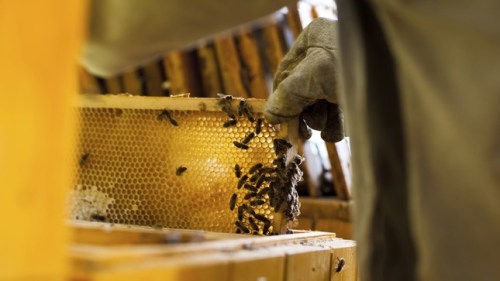
Beekeepers are suing the Environmental Protection Agency (EPA) over its approval of a chemical they say kills honey producers.
The pesticide sulfoxaflor is “highly toxic” to bees and other insects, the groups say, and could be contributing to broader declines of bee populations around the world.
“This case is really quite simple: bees are getting wiped out, and yet the EPA rubber stamped another bee-killing pesticide,” said Earthjustice attorney Greg Loarie in a statement on Friday. “EPA failed the beekeeping industry and all of us who rely on a sustainable food supply by refusing to consider threats to pollinators from this new pesticide.”
Bees are necessary to pollinate a range of agricultural crops, and benefit as much as one-third of all food and beverages.
Since 2006, scientists have worried about a sharp decline in bee populations, known as colony collapse disorder, which some have blamed on pesticides.
The Pollinator Stewardship Council, the National Honey Bee Advisory Board, American Honey Producers Association, the American Beekeeping Federation and individual beekeepers are suing the EPA to get it to withdraw its approval of the Dow Chemical pesticide. The groups are being represented by EarthJustice.
They say that the agency ignored concerns about Dow’s field tests and needs to issue stronger labeling requirements to limit the hazard the substance poses to bees.
Sulfoxaflor is in a class of pesticides known as neonicotinoid. This month, a European Union ban of three different neonicotinoids went into effect, which policy makers there said was necessary to protect bees. The suspension will last for two years.
The EPA has declined to take similar steps to restrict the sales of the pesticides.
In August, however, the agency released new labels for pesticides containing neonicotinoids warning that they can “kill bees and other insect pollinators.”
Source: http://thehill.com/blogs/regwatch/court-battles/192523-epa-sued-over-bees
.
wcba
Wasps and Honeybees Can Remember Individual Faces
Posted in In the News, Science on 10 December 2013| 1 Comment »
December 6, 2013 | by Lisa Winter
![Honey bee 01_thumb[6]](https://wilsoncountybeekeepers.org/wp-content/uploads/2013/12/honey-bee-01_thumb6.jpg?w=150&h=110) Remember that bee you swatted at and tried to kill, but it ended up getting away? Watch your back, because it knows what you look like. New research reveals that certain paper wasps and honeybees can remember distinct characteristics of individual faces. This came as a surprise to researchers who did not expect to see such advanced social abilities in creatures with such tiny brains.
Remember that bee you swatted at and tried to kill, but it ended up getting away? Watch your back, because it knows what you look like. New research reveals that certain paper wasps and honeybees can remember distinct characteristics of individual faces. This came as a surprise to researchers who did not expect to see such advanced social abilities in creatures with such tiny brains.
Humans are excellent at identifying people based on looks. Other animals, like crows, have been documented as being able to identify individuals too, though their brains are much bigger and they are generally regarded as much more intelligent than these paper wasps. Honeybees were also shown to be able to recognize different faces, including those belonging to humans.
When these insects view an individual (be it another insect or the person who just pissed them off by swinging a newspaper at them), their field of vision is broken up into hexagons from the thousands of ommatidia that make up the compound eye. Essentially, they process information based on these chunks from the structures in the eye that act as individual units and put the entire picture together. It might not be very clear compared to what we are used to since they don’t have a pupil to regulate the amount of light coming in onto the retina, but it is good enough to allow wasps and bees to discern prominent facial features that can be used for identification.
Understanding how these insects are able to achieve this high level of individual detection with such a relatively simple brain might be able to inspire new facial recognition programs. This research was announced by Elizabeth Tibbetts from the University of Michigan published a paper on these results in the journal Ethology. Her colleague Adrian Dyer from RMIT University has published five papers this year regarding Hymenoptera vision.
Source: http://www.iflscience.com/plants-and-animals/wasps-can-remember-individual-faces
.
wcba
We Made the News During the Fair
Posted in In the News, Video on 28 August 2013| Leave a Comment »
If you missed it, WSMV Channel 4 reported from the Honey Show booth during the Fair last week and our very own Petra made the news.
http://www.wsmv.com/video?clipId=9209620&autostart=true
Thank you Petra, Carey and everyone who volunteered during the Fair this year.
.
wcba
WCBA Meeting
Landscaping for Pollinator’s Health (emphasis on honeybees) w/ Lucas Holman13 October 2025
Got a swarm?
DON'T call an exterminator!
Call a BEEKEEPER.
List of Swarm Catchers
.WCBA Membership
WCBA Membership Application
.WCBA Meeting Minutes
Meeting Minutes ArchiveBlog Stats
- 150,952 hits

 Wilson County Beekeepers